


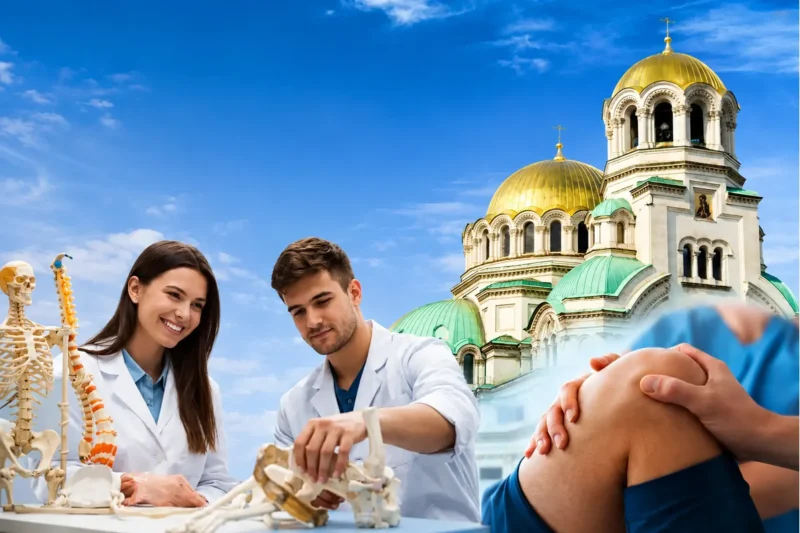
If you’re looking to study physiotherapy in Europe in English without taking on six-figure debt, Bulgaria is worth serious consideration as a structured EU-accredited alternative.
This isn’t about settling for less. It’s about understanding that tuition fees reflect the cost of living in a country – not the quality of the academic framework behind the degree. Bulgaria is a full European Union member state, its universities operate within the Bologna Process, and graduates receive degrees structured under the European Credit Transfer System (ECTS) – the standardized academic framework used across the European Higher Education Area.
For students from the UK, Ireland, Italy, and beyond who are struggling with limited seats, competitive entry exams, or simply unaffordable tuition, Bulgaria offers a clear and structured alternative.
What Does Studying Physiotherapy in Bulgaria Actually Involve?
Studying physiotherapy in Bulgaria follows a structured European academic framework that combines theoretical medical knowledge with progressive clinical training. Before choosing this pathway, international students should understand how the program is structured, what subjects are covered, and how the academic title of kinesitherapy fits within the broader physiotherapy profession.
Physiotherapy in Bulgaria
Students researching how to study physiotherapy in Europe will encounter one terminology difference when looking at Bulgarian programs: the degree is awarded under the academic title Kinesitherapy.
This does not represent a different healthcare profession but rather a regional academic title used for physiotherapy training. Kinesitherapy is the Bulgarian academic designation for the same field of study and clinical practice internationally recognised as physiotherapy. The curriculum covers the same core disciplines such as anatomy, biomechanics, rehabilitation, neurological and orthopaedic physiotherapy, and clinical placement that you would find in any structured European physiotherapy degree.
The distinction is primarily linguistic and academic rather than related to clinical scope or professional role. Across Bulgaria and parts of Central and Eastern Europe, kinesitherapy has historically been used as the formal academic title within university faculties. In practice, graduates work as physiotherapists, applying the same clinical methods and rehabilitation principles taught in physiotherapy programs across the EU.
For international students considering a physiotherapy degree in Bulgaria, this is worth understanding early – particularly when researching program content, communicating with home-country regulatory bodies, or comparing curricula across European institutions. The substance of the education is equivalent. The title on the document is simply the Bulgarian academic convention.
In Bulgaria, the academic term “Kinesitherapy” is historically used within university faculties, but international students should understand that the professional role aligns with physiotherapy practice within the European health care education framework.
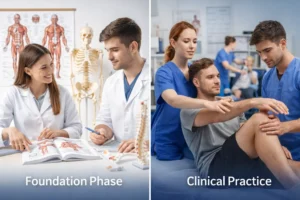 What You Study: From Foundation to Clinical Practice
The program is built in two clear phases.
In years one and two, students develop their scientific foundation. This covers human anatomy, physiology, biomechanics, kinesiology, pathology, and core rehabilitation principles. These aren’t introductory overviews – they form the clinical reasoning base that every physiotherapy graduate needs before touching a patient.
From year three onwards, the focus moves into applied practice. Subjects include orthopaedic rehabilitation, neurological rehabilitation, sports physiotherapy, therapeutic exercise prescription, and structured clinical placements. Hands-on hours increase progressively, and by the final year, students are functioning in real clinical environments alongside qualified practitioners.
By graduation, students complete a curriculum aligned with European physiotherapy education standards, supporting future professional registration pathways depending on the regulatory requirements of their destination country.
How Long Does a Physiotherapy Degree in Bulgaria Take?
The Bachelor of Physiotherapy (Kinesitherapy) runs for 4 years, awarding 240 ECTS credits on completion – the standard European framework for a full undergraduate degree in a health science discipline.
After completing the Bachelor’s, students can continue into a 1-year Master’s program for advanced specialisation, whether clinical or research-focused.
Total academic pathway: 4 to 5 years, which is consistent with standard physiotherapy study duration across many European undergraduate and postgraduate pathways.
One practical advantage worth noting: Bulgaria does not use a lottery-based or numerus clausus admission system for this program. Students who meet the entry requirements are admitted on a predictable timeline. For students coming from Italy, where national entrance exam results can cost them a full academic year, this matters a great deal.
Where Can You Study Physiotherapy in Bulgaria?
The primary institution offering an English-taught physiotherapy program in Sofia is the National Sports Academy Vasil Levski. This is a specialised institution focused on sports science, movement science, and rehabilitation disciplines – making it a strong academic environment for physiotherapy training rather than a secondary programme within a general university structure.
Sofia itself is Bulgaria’s capital and a European Union city with a well-established international student community. Students already come here from across Europe and beyond to study medicine, dentistry, pharmacy, and health sciences. The city has the infrastructure, including housing, transport, healthcare, and a supportive social environment, to properly support international students.
How Much Does It Cost to Study Physiotherapy in Bulgaria?
This is where Bulgaria becomes very difficult to ignore for students comparing options across Europe.
Tuition: €4,000 per year – €16,000 for the full 4-year Bachelor’s degree.
To put that in context: UK tuition for home students is £9,250 per year. International student fees in UK universities regularly reach £15,000–£25,000 annually. In Ireland, physiotherapy programs typically cost €14,000–€22,000 per year. When you factor in living costs in London, Dublin, or Milan, total program costs frequently exceed €100,000–€170,000.
Bulgaria’s full 4-year cost, including tuition, accommodation, and living expenses combined, typically ranges between €45,000 and €50,000.
That’s a realistic saving of €60,000 to €100,000+ compared to studying the same degree in the UK or Ireland.
Physiotherapy Study Cost Comparison
| Country | Tuition per Year | Total Tuition | Estimated Total Cost (4 years) | Admission Difficulty |
|---|---|---|---|---|
| Bulgaria | €4,000 | €16,000 | €45,000–€50,000 | Predictable admission |
| UK | £9,250–£25,000 | €60,000–€100,000+ | €110,000–€170,000 | Highly competitive |
| Ireland | €14,000–€22,000 | €56,000–€88,000 | €100,000+ | Limited seats |
| Italy | Low tuition | varies | depends on city | Entrance exam required |
The comparison above highlights why many Italian students consider Bulgaria a structured and financially sustainable alternative.
Accommodation and Living Costs in Sofia
Students can apply for on-campus dormitory housing at approximately €100 per month – one of the lowest student housing costs anywhere in the European Union. For students who prefer more independence, shared apartments typically run €250–€400 per month, with studio apartments ranging from €400–€600.
The average monthly student budget in Sofia is typically around €600–€800, including accommodation, food, transport, and personal expenses.
Compared to what students spend in London, Dublin, or Milan, this is a different financial reality entirely.
Want to Study Physiotherapy in Bulgaria?
Get a free eligibility assessment and find out if you qualify, what documents you need, and how the application process works.
Will a Physiotherapy Degree from Bulgaria Be Recognised?
This is the question families ask most often, and it deserves a direct and honest answer.
Bulgaria is an EU member state. The physiotherapy program at National Sports Academy Vasil Levski follows the 240 ECTS framework under the Bologna Process. This is a European-accredited university degree delivered within the EU higher education framework – not an offshore qualification or unregulated certificate.
That said, professional registration as a physiotherapist is regulated separately in each country. The UK has the HCPC. Ireland has CORU. Italy has its own national regulatory framework. Graduates who intend to practice in a specific country will need to go through that country’s recognition process – but this applies to any graduate who completed their degree abroad, regardless of which EU country they studied in.
The important step is researching your target country’s requirements before you enroll – not after you graduate. As an education consultancy specialising in European health science programmes, igeneration.agency walks students and families through this as part of the initial consultation and explains exactly how we guide students step-by-step through the admission process, ensuring regulatory clarity from the start. If you want a personalised eligibility assessment and clear next steps, you can contact us and receive guidance tailored to your goals.
Who Is This Program Right For?
Studying physiotherapy in Bulgaria makes particular sense for certain groups of students.
Students from Italy who didn’t secure a seat through the national entrance exam system and don’t want to lose another academic year retrying. Bulgaria’s admission process is structured and predictable, with a clear timeline from application to enrollment.
Students from the UK or Ireland for whom domestic or other Western European programs have become financially out of reach. The cost difference over four years is large enough to meaningfully change a graduate’s financial position – less debt, more options, earlier professional freedom.
Students who want an EU-accredited physiotherapy degree but can’t access one easily at home, whether due to competition, cost, or both.
Students ready for independent living in an international environment. Sofia has hosted European students in health science fields for years. The community exists, the support structures are in place, and you won’t be navigating this alone.
What Families Often Underestimate About Studying Abroad
The financial case for Bulgaria is clear. But there’s something that doesn’t show up in tuition comparisons.
Students who complete a degree abroad learn to manage a new city, build their own routines, form friendships across nationalities, and solve problems independently. As a result, they often become noticeably more capable, not only academically but also personally and professionally.
This isn’t an abstract benefit. When two graduates with comparable degrees apply for the same clinical position, the one who spent four years demonstrating independence, adaptability, and cross-cultural competence tends to stand out. Hiring managers notice. It’s consistent enough to be worth factoring into the decision.
Studying abroad isn’t right for every student. But for those who are ready, the personal development that comes with it is real and lasting.
How to Apply for a Physiotherapy Degree in Bulgaria
The application process involves preparing your academic documents, reviewing them for eligibility, and completing the university’s admission requirements. igeneration.agency manages the entire process, from the initial eligibility assessment to final enrollment confirmation, so students are not left navigating incomplete or unclear information on their own.
Intake capacity is limited each year, so early applications are recommended for students planning to study physiotherapy in Europe in English.
If you’re considering this route for yourself or for your child, the starting point is a free eligibility assessment. This gives you a clear picture of whether you qualify, what documents are required, and what the realistic application timeline looks like before you commit to anything.
Studying physiotherapy doesn’t have to mean starting your career with six-figure debt or losing years to entrance exam retries. Bulgaria offers a legitimate, EU-accredited path at a fraction of the cost, in a European capital that’s well set up for international students.
Ready to Check If You Qualify?
Speak with iGeneration Agency and get clear guidance on eligibility, documents, deadlines, and next steps for studying physiotherapy in Bulgaria.