



NACID Bulgaria: Foreign Diploma Recognition for University Admission in 2026
Last updated: 31 July 2026
Applying to a university in another country usually involves more than submitting an application form and school grades. International students who completed their secondary education outside Bulgaria may first need to prove that their qualification corresponds to completed Bulgarian secondary education.
This procedure is handled by the National Centre for Information and Documentation, better known as NACID Bulgaria.
Since 1 October 2025, NACID has been responsible for the recognition of completed foreign secondary education in Bulgaria. For prospective university students, the resulting certificate can confirm the level of the foreign qualification and convert the grades included in the diploma to the Bulgarian grading system.
The procedure can appear straightforward, but the requirements are not identical for every student. The country where the diploma was issued, the type of qualification, the available academic records and the intended university programme can all affect the documents that must be submitted.
This guide answers five of the questions international students most often ask about NACID recognition in Bulgaria.
In This Guide
- What Is NACID Bulgaria, and Do I Need NACID Recognition?
- What Documents Are Required for NACID Recognition?
- Does My Diploma Need an Apostille, Legalisation and Bulgarian Translation?
- How Long Does NACID Recognition Take, and How Much Does It Cost?
- Can I Apply to NACID Online and Check My Application?
- Common NACID Mistakes That Can Delay an Application
- Do International Students Need NACID to Study Medicine in Bulgaria?
- Frequently Asked Questions About NACID Bulgaria
1. What Is NACID Bulgaria, and Do I Need NACID Recognition?
NACID stands for the National Centre for Information and Documentation. It is the Bulgarian institution responsible for a number of services related to foreign educational qualifications, academic recognition and access to education or employment in Bulgaria.
For university applicants, the relevant service is usually the recognition of secondary education completed at a school outside Bulgaria.
The NACID certificate is an official confirmation that the foreign qualification corresponds to completed secondary education in Bulgaria. It may be used for:
- continuing education at a Bulgarian university;
- converting subjects and grades to the Bulgarian grading system;
- proving completed secondary education for employment;
- certain other administrative purposes in Bulgaria.
The official NACID service for foreign secondary-school qualifications is listed as Service 3436 – Certificate for Recognition of Secondary Education Acquired at a School in a Foreign Country.
Do all international university applicants need it?
Students should not assume that the procedure is identical for every university or every admission route. In many cases, applicants with a foreign secondary-school diploma will need recognition or grade conversion before their final university enrolment.
The university may require evidence that:
- the applicant has completed secondary education;
- the diploma gives access to higher education in its country of origin;
- the required subjects appear in the diploma or transcript;
- grades in subjects such as Biology and Chemistry can be converted to the Bulgarian six-point system.
This is particularly important for students applying to Medicine, Dentistry, Pharmacy, Veterinary Medicine and other competitive programmes where admission rankings may include school grades.
Secondary education recognition is not the same as university degree recognition
NACID handles several different procedures. Recognition of a secondary-school diploma for university admission should not be confused with recognition of a foreign bachelor’s or master’s degree.
Foreign higher-education qualifications follow a separate procedure. Regulated professions may also involve another competent authority, depending on the profession and the purpose of the recognition.
For a student applying directly after secondary school, the relevant process is normally the recognition of completed foreign secondary education.
2. What Documents Are Required for NACID Recognition?
There is no single document list that applies in exactly the same way to every country.
NACID publishes country-specific instructions because educational systems, diploma formats, and legalisation rules differ. A document accepted from one country may not be sufficient for a qualification issued in another.
A typical application may include:
- a completed application form;
- the final secondary-school diploma or certificate;
- a transcript, mark sheet, diploma supplement, or other academic record;
- a document confirming that the qualification gives access to university education in the issuing country, when this is not clear from the diploma;
- a Bulgarian translation of the required documents;
- evidence of the required Apostille or legalisation;
- proof of payment of the administrative fee;
- a copy of the applicant’s identity document;
- a power of attorney when the procedure is handled by an authorised representative.
The exact diploma and supporting documents depend on the country where the student completed secondary education. NACID maintains detailed instructions covering the required documents, certifications, and translations for individual countries.
What if Biology or Chemistry is not shown in the final diploma?
This is a common issue for medical university applicants.
Some education systems issue a final diploma that confirms graduation, but does not show every subject and grade studied during secondary school. In that situation, the applicant may need to submit an additional transcript, academic record, mark sheet or examination certificate.
NACID provides a separate service for converting grades in subjects that were studied but are not included in the final secondary-school diploma. This is listed as Service 3434 – Certificate for Conversion of Grades in Subjects Not Included in the Secondary Education Diploma.
This distinction matters because the main recognition certificate cannot automatically include grades that do not appear in the diploma submitted for recognition.
For example, a student applying to Medicine may have completed Biology and Chemistry, but the final diploma may only show an overall result. The additional academic document must then be reviewed to determine whether a separate grade-conversion request is required.
Does NACID require proof that the diploma gives access to the university?
Sometimes.
Certain diplomas clearly state that the holder is entitled to apply to higher education. For other qualifications, NACID may require a separate document issued by the school, examination board, education authority, or another competent institution.
The country-specific NACID instructions should be checked before requesting this document. For some countries and qualifications, NACID has already confirmed that the diploma provides access to higher education, and no separate certificate is required.
This is one reason why students should not prepare documents based only on a general checklist found online.
3. Does My Diploma Need an Apostille, Legalisation and Bulgarian Translation?
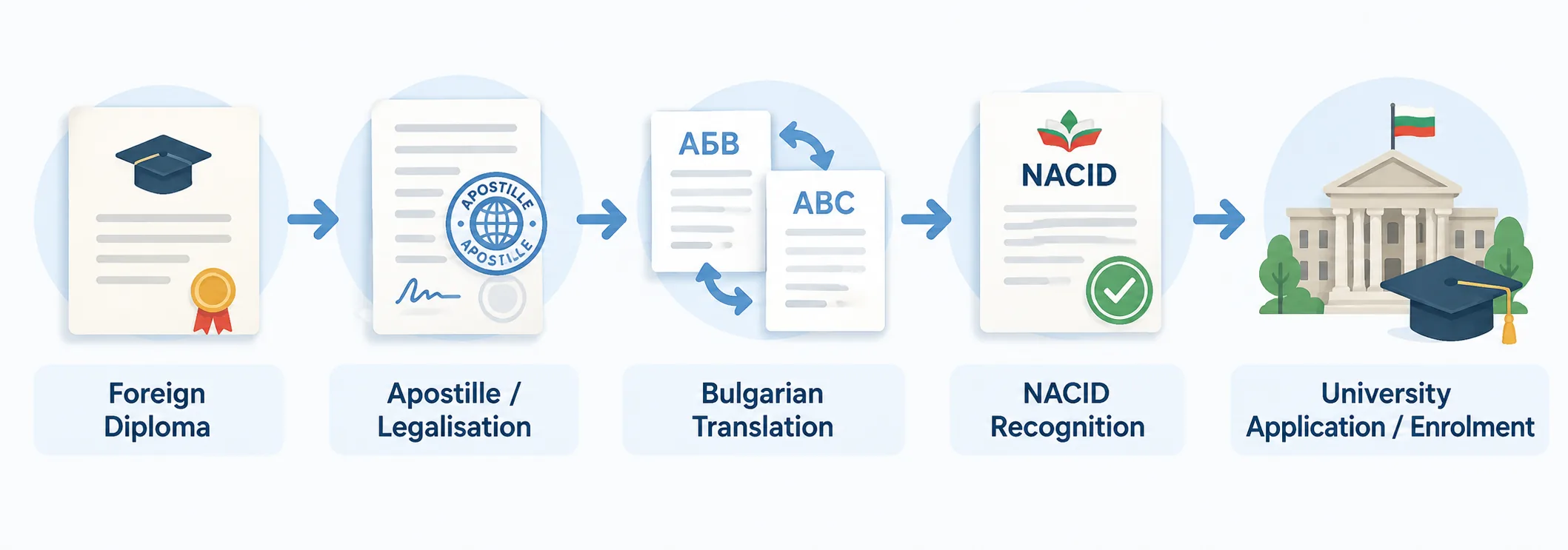
In many cases, the answer is yes. However, Apostille, legalisation, translation, and NACID recognition are separate steps.
They should not be treated as interchangeable terms.
What is an Apostille?
An Apostille confirms the authenticity of a public document for use in another country that participates in the Hague Apostille Convention.
For documents issued in a country covered by the Convention, the competent authority in that country generally certifies the relevant signature through an Apostille.
The Apostille is normally obtained in the country where the educational document was issued. It is not issued by NACID for a foreign diploma.
NACID’s official instructions state that documents issued in countries participating in the Hague Convention are authenticated by the competent authority through an Apostille.
What happens when the country does not use Apostilles?
Documents issued in countries that are not parties to the Hague Apostille Convention may require a longer legalisation procedure.
Depending on the country, this can involve:
- certification by the relevant education authority;
- certification by the Ministry of Foreign Affairs in the issuing country;
- certification through the Bulgarian embassy or another competent diplomatic mission.
The precise sequence must be checked for the country concerned. A general legalisation rule should never be applied without verifying NACID’s current country-specific instructions.
A notarised copy is not always enough
One of the most important details in the NACID instructions is the difference between:
- certification that a copy corresponds to an original; and
- certification that the signature and origin of the document are authentic.
A notarised copy does not necessarily prove the authenticity required for recognition. NACID explicitly warns that certification of a true copy is not equivalent to certification of the document’s authenticity.
This is a frequent source of confusion. A document can look formally certified and still have the wrong type of certification for the NACID procedure.
Is a Bulgarian translation required?
The documents submitted for recognition must be translated into Bulgarian.
When the translation is completed in Bulgaria, the translator’s signature should be notarised. When it is completed through a Bulgarian embassy, the translator’s signature should be certified by the embassy.
The translation should accurately include:
- names;
- dates;
- subjects;
- grades;
- seals;
- stamps;
- handwritten notes;
- certification text;
- Apostille information.
Even a small inconsistency in the spelling of a name or the translation of a subject can create questions during the review.
Apostille and NACID recognition are not the same thing
An Apostille does not recognise the educational level of a diploma.
It only authenticates the relevant public document or signature. NACID then evaluates the foreign qualification and determines whether it corresponds to completed secondary education in Bulgaria.
A student may therefore need both:
- the correct Apostille or legalisation; and
- the NACID recognition procedure.
Completing only one of these steps may not be sufficient for university admission.
4. How Long Does NACID Recognition Take, and How Much Does It Cost?
The official NACID fee for recognition of completed foreign secondary education is €25.56.
Translation, Apostille, legalisation, notarisation, courier, and representation costs are separate and are not included in this administrative fee.
How long does the procedure take?
The expert commission should issue its decision within one month from the date on which all required documents have been submitted.
This detail is important. The period does not necessarily run without interruption from the day the first application is filed.
The official deadline stops running while:
- missing documents are being provided;
- problems in the application are being corrected;
- the existing documents are insufficient for a decision;
- additional documents or information are required.
NACID confirms that the one-month period begins after all documents have been presented and may be suspended while deficiencies are corrected or additional evidence is supplied.
Is there a fast-track NACID service?
Students should not plan their university application on the assumption that an urgent paid service will be available.
The safer approach is to begin preparing the documents as soon as possible or simply get in touch with our team so we can make this process very fast! Igeneration Agency can make the whole process very smooth, professional and in short terms.
A student who starts the procedure shortly before an enrolment deadline may not have enough time to correct an Apostille, replace an incomplete transcript or provide an additional certificate.
When should a medical university applicant begin?
The recognition procedure should be planned together with:
- the university application deadline;
- entrance-examination registration;
- Biology and Chemistry preparation;
- legalisation and translation;
- Ministry of Education procedures, where applicable;
- visa D preparation for non-EU students;
- final university enrolment.
NACID recognition should not be treated as an isolated step at the end of the application.
A document problem that appears late in the process can affect the student’s ability to enrol, even when the entrance examination has already been passed.
5. Can I Apply to NACID Online and Check My Application?
NACID operates an electronic services portal through which applicants can access the service for recognition of foreign secondary education.
The relevant online service is available through the official NACID Electronic Services Portal.
Applicants should carefully follow the current portal instructions regarding registration, electronic identification, uploaded documents and payment.
Depending on the document and the available electronic verification system, NACID may still require an original or another form of evidence when authenticity cannot be confirmed electronically.
Can someone apply on the student’s behalf?
An application may be handled through an authorised representative when the required power of attorney and supporting identification documents are provided.
Additional rules apply when the applicant is under 18. Depending on who submits the application, NACID may require parental consent, identity documents, a birth certificate or an appropriately prepared power of attorney.
This is especially relevant for applicants who complete secondary school before turning 18.
Can the issued document be checked online?
NACID maintains an electronic register for certificates, grade-conversion documents, and recognition decisions issued after 1 October 2025.
The information can be accessed using the code stated on the issued document.
Applicants with an active electronic application can also use the portal to follow the progress of their request through their account and the available application information.
Common NACID Mistakes That Can Delay an Application
Most problems do not begin with the application form itself. They begin earlier, when the wrong document is legalised, or an incomplete academic record is prepared.
Common mistakes include:
- obtaining an Apostille for a notarised copy when the original signature requires authentication;
- translating the diploma before all certifications have been added;
- submitting a diploma without the required transcript or mark sheet;
- failing to provide evidence that the qualification gives access to higher education;
- assuming that every country follows the same legalisation procedure;
- omitting Biology, Chemistry, or another subject needed for university admission;
- submitting an additional transcript without requesting grade conversion;
- using inconsistent spelling of the student’s name across documents;
- leaving seals, stamps, or handwritten certifications untranslated;
- beginning the process too close to the university deadline;
- assuming that an Apostille automatically means the diploma has been recognised.
The safest order depends on the country and the documents involved. In some cases, completing the steps in the wrong sequence means that the legalisation or translation must be repeated.
Not Sure Your NACID Documents Are Correct?
Send us your diploma and application details and our team can check what documents, translations and certifications are required for your case.
Do International Students Need NACID to Study Medicine in Bulgaria?
Students who completed secondary education outside Bulgaria may need NACID recognition and grade conversion as part of the admission or enrolment process for a Bulgarian medical university.
A typical medical university application may involve:
- an initial eligibility assessment;
- selection of the appropriate Bulgarian medical university;
- preparation of the application documents;
- Apostille or legalisation;
- certified Bulgarian translations;
- NACID recognition and, where necessary, separate grade conversion;
- registration for the entrance examination;
- preparation for Biology, Chemistry, and English;
- submission to the university;
- final enrolment and tuition-fee payment;
- Ministry of Education and visa procedures for applicable non-EU applicants.
The order can vary according to the university, the applicant’s nationality, and the country where the diploma was issued.
Students can read our detailed guide to studying Medicine in Bulgaria. It explains the structure of the medical degree, available universities, tuition fees, entrance examinations, and the wider application process.
How iGeneration Agency Can Help With the NACID Process
NACID recognition is only one part of a successful international university application.
Students must also make sure that the documents prepared for NACID are consistent with the documents required by the chosen university. The university, NACID, the Ministry of Education, and the Bulgarian visa authorities may review related documents, but each institution has its own purpose and requirements.
iGeneration Agency can assist international students with:
- reviewing the diploma and academic records;
- identifying the applicable NACID requirements;
- checking whether additional proof of access to higher education is needed;
- explaining the correct Apostille or legalisation procedure;
- coordinating certified translations into Bulgarian;
- preparing the NACID application file;
- arranging representation when appropriate;
- identifying subjects that may require separate grade conversion;
- monitoring deadlines and document progress;
- coordinating NACID recognition with the university application;
- registering the applicant for the entrance examination;
- providing Biology, Chemistry, and English preparation materials;
- supporting the student through admission and final enrolment.
No agency or representative can control NACID’s official decision or guarantee that the institution will issue a result before a particular date. However, a properly reviewed and complete application can reduce avoidable delays caused by missing, incorrectly certified, or inconsistent documents.
Need Help With Your NACID Application?
Send us your documents and application details and our team will review your case and explain the next steps.
Request a Personal Assessment of Your Documents
Every student’s case is different.
The correct process depends on:
- the country where the diploma was issued;
- the type of secondary-school qualification;
- the documents available;
- the subjects shown in the diploma;
- the student’s age;
- the chosen university;
- the intended programme;
- the admission deadline;
- the applicant’s EU or non-EU status.
For this reason, it is better to have the documents checked before paying for translations, Apostilles, or legalisation.
Use the iGeneration Agency contact page to send us your nationality, country of education, intended programme, preferred university, and available documents. Our team will review the information and explain which steps are likely to apply to your case.
We can manage the complete application process professionally, coordinate the necessary stages, and help ensure that the documents are prepared and submitted within the relevant deadlines.
Frequently Asked Questions About NACID Bulgaria
Is NACID recognition the same as an Apostille?
No. An Apostille confirms the authenticity of a public document or signature. NACID recognition assesses the educational qualification and its correspondence to completed secondary education in Bulgaria.
Can I apply to NACID without translating my diploma?
The required documents must normally be accompanied by an appropriate Bulgarian translation prepared according to the applicable certification rules.
Does NACID convert school grades?
The recognition certificate can include subjects and grades shown in the final diploma. Subjects that do not appear in the diploma may require a separate grade-conversion service and an additional academic document.
Can iGeneration Agency submit the application for me?
An authorised representative can assist with the procedure when the necessary authorisation and supporting documents are prepared correctly. Different requirements may apply to applicants under 18.
Can I use a provisional certificate?
The answer depends on the country, the type of provisional document and the official NACID instructions. Some country-specific requirements expressly accept certain provisional certificates, while others require the final qualification.
Is a notarised copy sufficient?
Not always. Certification that a copy corresponds to an original is not necessarily the same as authentication of the original document or signature.
Can I start university before receiving the NACID certificate?
This depends on the university’s admission and enrolment rules. Applicants should obtain written confirmation from the university rather than assuming that the certificate can be submitted later.
How long is the NACID certificate valid?
The certificate confirms recognition of the completed qualification. Students should still check whether the receiving university requires a recently issued copy, electronic verification or any additional document.
What happens if NACID requests additional documents?
The procedure may be suspended until the requested documents or corrections are provided. This is why submitting a complete file from the beginning is so important.
Final Advice for International Students
The NACID procedure is manageable when the documents are prepared correctly and in the right order.
The most important step is not filling in the application. It is determining exactly which diploma, transcript, certification, translation and supporting evidence apply to the student’s country and qualification.
Before submitting an application:
- check the current NACID requirements for the issuing country;
- confirm whether the diploma itself proves access to higher education;
- identify all subjects and grades required by the university;
- obtain the correct Apostille or legalisation;
- arrange a complete Bulgarian translation;
- determine whether a separate grade-conversion application is necessary;
- allow enough time before the university deadline;
- keep copies and electronic records of every submitted document.
For applicants to Medicine, Dentistry, Pharmacy, or Veterinary Medicine, NACID recognition should be coordinated with the complete admission plan – not handled as an unrelated administrative task.
Careful preparation at the beginning can prevent repeated legalisation, additional translations, and last-minute problems during university enrolment.
Students who want the recognition procedure coordinated with their university application can ask iGeneration about professional NACID application assistance in Bulgaria.