


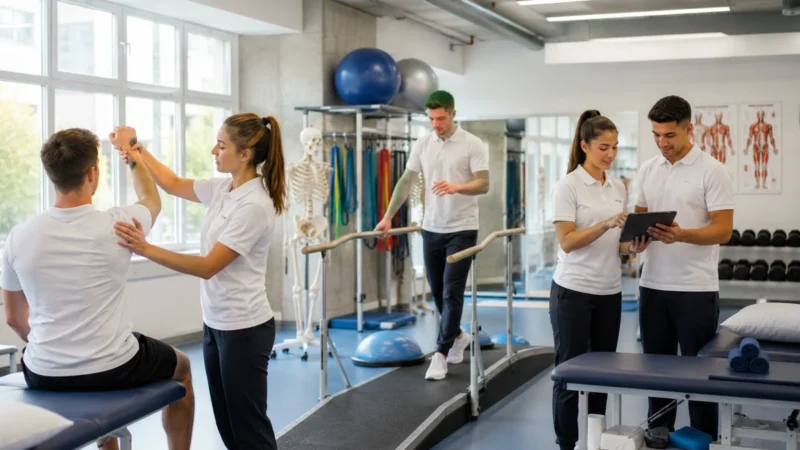
The National Sports Academy “Vasil Levski” in Sofia is a public, specialised university where sport science, movement, public health and rehabilitation are central academic fields. Its Bachelor of Science in Physiotherapy is designed for students who want a degree built around clinical assessment, therapeutic movement and supervised practice rather than a general health-science programme with only a small rehabilitation component.
The official programme page describes a 4-year full-time degree with 240 ECTS credits. Physiotherapy education at the Academy began in 1947, only five years after the institution was founded. International students can apply for the professional qualification of Kinesitherapist or Physiotherapist, and NSA currently publishes a tuition fee of €4,000 per year for bachelor programmes conducted in English.
For a wider comparison of universities, living arrangements and the Bulgarian education system, start with our guide to studying Physiotherapy in Bulgaria.
This structure is more accurate than dividing the degree into two purely theoretical years followed by two purely clinical years. Medical, movement and professional subjects appear throughout the programme, while the amount and complexity of practice increase as students progress.
Programme snapshot: NSA publishes a 4-year Physiotherapy BSc worth 240 ECTS, with more than 1,500 hours of supervised clinical practice. The curriculum combines medical sciences, movement analysis, specialist physiotherapy subjects, electives and practical courses.
Why Study Physiotherapy at a Sports Academy?
Physiotherapy is concerned with restoring movement, function and participation after injury, illness or disability. That makes a university focused on movement science a logical setting for the degree. At NSA, the programme sits inside the Faculty of Public Health, Health Care and Tourism and is supported by two specialist academic units: the Department of Kinesitherapy and Rehabilitation and the Department of Theory and Methodology of Kinesitherapy. The academic environment extends beyond competitive sport. Students study the structure and function of the human body, clinical conditions, assessment methods, rehabilitation planning and the use of therapeutic exercise. The Academy also provides access to sport facilities and scientific equipment that can support the study of biomechanics, functional diagnostics, anthropometry and movement. This combination can be particularly relevant for students interested in musculoskeletal rehabilitation, exercise therapy, sports injuries or future work with physically active patients. The degree is still a broad physiotherapy qualification, not a sports-only course.Programme Structure at a Glance
The official English programme page divides the degree into five blocks. Each block develops a different part of the knowledge and skills required for professional practice.| Programme block | Main purpose |
|---|---|
| Behavioural and physical education subjects | Psychology, pedagogy, research methods, statistics, informatics, movement analysis and adapted physical activity |
| Basic biological and medical subjects | Anatomy, kinesiology, biomechanics, biochemistry, physiology, sports medicine and hygiene |
| Specialist physiotherapy subjects | Clinical assessment, pathology, orthopaedics, neurology, paediatrics, internal diseases, surgery and rehabilitation |
| Elective subjects | Additional topics selected according to the student’s academic interests |
| Specialised practice | Integration of academic learning with supervised clinical work and research activity |
What Subjects Will You Study?
The early curriculum builds the scientific foundation required to understand movement and disease. Published modules include anatomy and kinesiology, biomechanics with physics and motor control, biochemistry, physiology, psychology, medical pedagogy, research methods and applied statistics. Professional physiotherapy subjects begin from the first stages of the course. Students encounter the fundamentals, means and methods of physiotherapy before moving into diagnostic and condition-specific modules. The published curriculum includes:- Functional and visual diagnostics
- Diagnostics of the locomotor system
- General pathology and pathophysiology
- Pathobiomechanics and pathokinesiology
- Orthopaedics, traumatology, orthotics and prosthetics
- Physiotherapy in orthopaedic and traumatic conditions
- Physiotherapy in internal diseases
- Neurological and psychiatric conditions
- Physiotherapy in paediatrics and geriatrics
- Physiotherapy in surgery, obstetrics and gynaecology
- Massage and rehabilitation
Clinical Practice and Hospital Experience
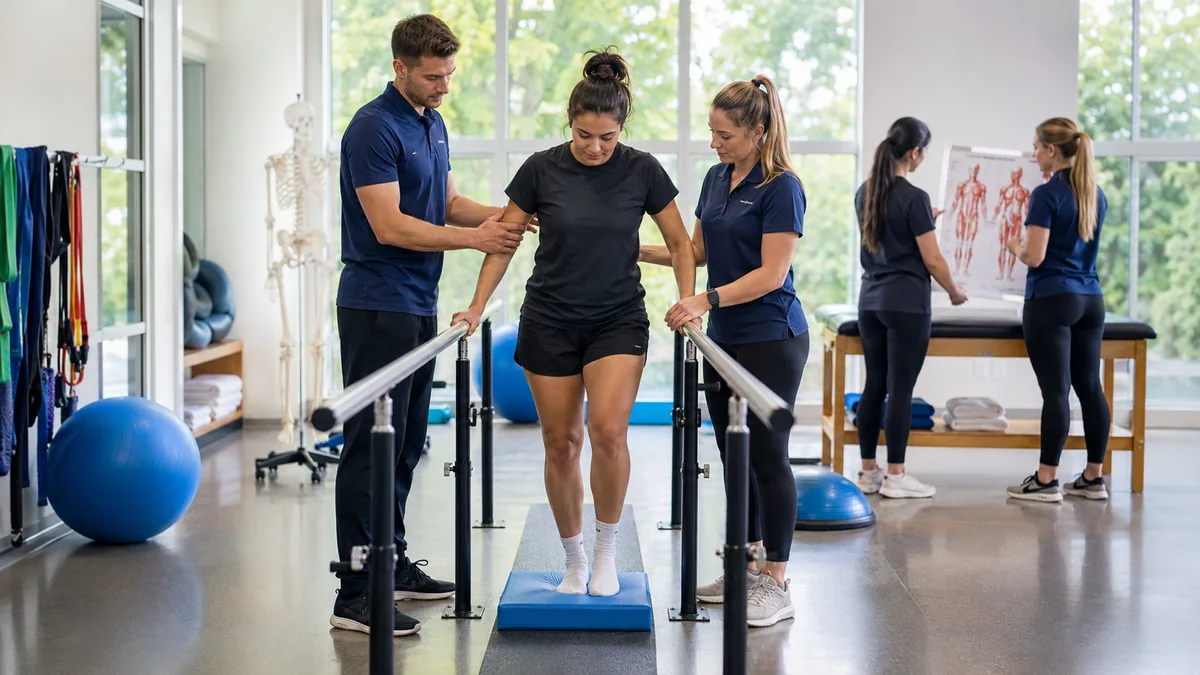
The official programme description states that specialised practice exceeds 1,500 hours across part-time and full-time supervised clinical activity. Practice allows students to apply assessment, clinical reasoning and treatment planning under supervision. The Department of Kinesitherapy and Rehabilitation reports that educational practice, summer clinical practice and the pre-graduation internship are organised in more than 30 medical institutions. These include university and multidisciplinary hospitals, specialised clinics, departments, diagnostic centres and consultation centres. This is one of the strongest verified features of the programme. It shows that practical education is not limited to demonstrations inside a university classroom. Applicants should still request the current placement schedule, the language arrangements used in clinical settings and the method by which hours are recorded. Detailed documentation may later be required by professional regulators outside Bulgaria.Kinesitherapy and Physiotherapy: Why Two Names Appear
NSA uses both Kinesitherapy and Physiotherapy across its English and Bulgarian pages. The foreign-student page lists the professional qualification as “Kinesitherapist / Physiotherapist”, while the English bachelor page uses “Physiotherapy”. The terms refer to the same professional field within the NSA programme, but applicants should not assume that the title alone guarantees registration in another country. Regulators normally review the completed qualification, curriculum, clinical education and supporting documents. Graduates intending to work in the UK or Ireland can read our separate guide to Physiotherapy degree recognition through HCPC and CORU.Campus and Facilities in Sofia
The main NSA campus is located in Studentski Grad, Sofia’s university district. The Academy states that its facilities cover approximately 20 hectares and include three educational buildings, lecture and workshop rooms, methodological laboratories, remedial physical culture gyms, an indoor swimming pool and multiple indoor and outdoor sport facilities. The published campus inventory includes 14 indoor sports halls, football and athletics areas, tennis courts, a library, reading rooms, student accommodation, canteens and medical services. NSA also operates mountain and seaside training bases used across its wider educational activity. Physiotherapy students should distinguish between university-wide facilities and facilities used directly in their course. The campus offers a strong movement and sport environment, but access to individual laboratories, centres or sports bases depends on the timetable and the academic module.Academic Staff and Research Environment
Specialist physiotherapy subjects are taught through the Academy’s kinesitherapy departments. The official programme page also states that pathology and clinical medicine subjects involve medical professors from the Faculty of Medicine in Sofia, while professional physiotherapy subjects are taught by physiotherapy lecturers and staff connected with teaching hospitals. NSA’s scientific infrastructure includes a Center for Scientific and Applied Activities in Sports. The Academy lists capabilities in functional diagnostics, sports-pedagogical testing, anthropometric analysis, biokinetic analysis and biochemical analysis. Students are not automatically involved in every research activity. The relevance is that the institution has equipment and staff working in areas closely connected to human movement, physical function and applied health science.Is the NSA Physiotherapy Programme Right for You?
Send your diploma and applicant details for a free review of your academic eligibility and international admission route.
Request Free AssessmentTuition Fees and Programme Costs
NSA currently publishes a tuition fee of €4,000 per academic year for bachelor programmes conducted in English. At the same published rate, four years would total €16,000 in tuition. The figure does not include accommodation, food, travel, document preparation, health insurance or personal expenses. Fees may change between admission cycles, so applicants should confirm the amount in writing before enrolment and should not calculate the full degree cost from one year’s fee alone.| Programme detail | Published information |
|---|---|
| Degree | Bachelor of Science in Physiotherapy |
| Study mode | Full-time |
| Duration | 4 academic years |
| Credits | 240 ECTS on the English programme page |
| Supervised clinical practice | More than 1,500 hours |
| Published English-language bachelor tuition | €4,000 per year |
Admission in Brief
The foreign-student route lists a secondary-school diploma, official transcript, identification, photographs, proof of the administrative payment and a document confirming the right to continue to higher education in the country where secondary school was completed. Documents must meet Bulgarian recognition, translation and legalisation requirements. NSA publishes different rules for different applicant categories. A separate university entrance examination is not listed for the paid foreign-student route described on the international pages. The detailed distinction is covered in our guide to studying Physiotherapy in Bulgaria without a separate entrance exam. For the full application sequence, use the separate Physiotherapy admission requirements guide.Important Points to Confirm With NSA
Some official NSA pages describe different applicant groups or versions of the curriculum. Before applying, request confirmation of:- The exact admission category assigned to you
- The language of lectures, examinations and each clinical placement
- The current curriculum and ECTS total for the international programme
- The method used to document clinical hours and placement settings
- The accepted evidence of English ability
- The current tuition fee and payment schedule
- The documents issued with the degree, including the diploma supplement
Frequently Asked Questions
Is the National Sports Academy a public university?
Yes. NSA is a specialised public higher education institution in Bulgaria. It was founded in 1942, and Physiotherapy education at the Academy began in 1947.How long is the Physiotherapy degree at NSA?
The official English programme page describes a 4-year full-time Bachelor of Science in Physiotherapy worth 240 ECTS credits.How much clinical practice does the programme include?
The official programme description states that specialised supervised clinical practice exceeds 1,500 hours. The department reports placements across more than 30 medical institutions and clinical settings.Is Kinesitherapy different from Physiotherapy?
NSA uses both terms for the programme and lists the professional qualification as Kinesitherapist or Physiotherapist. Recognition outside Bulgaria depends on the destination country’s professional regulator.What is the published tuition fee?
NSA currently lists €4,000 per year for bachelor programmes conducted in English. Applicants should confirm the fee for their intake before enrolment.Is every part of the programme taught in English?
NSA publishes an English-language bachelor tuition route and offers Physiotherapy to foreign students. The public pages reviewed do not clearly describe the language arrangement for every clinical placement, so applicants should obtain written confirmation.Official NSA Sources
- NSA Bachelor Degree Programme in Physiotherapy
- NSA Department of Kinesitherapy and Rehabilitation
- NSA Faculty of Public Health, Health Care and Tourism
- NSA University Premises and Campus Facilities
- NSA Foreign Students Information
- NSA How to Apply and Tuition Fees
Check Your Eligibility Before Preparing Documents
iGeneration can review your diploma, applicant category and documents, then explain the next steps for the NSA Physiotherapy programme.
Request Free Assessment